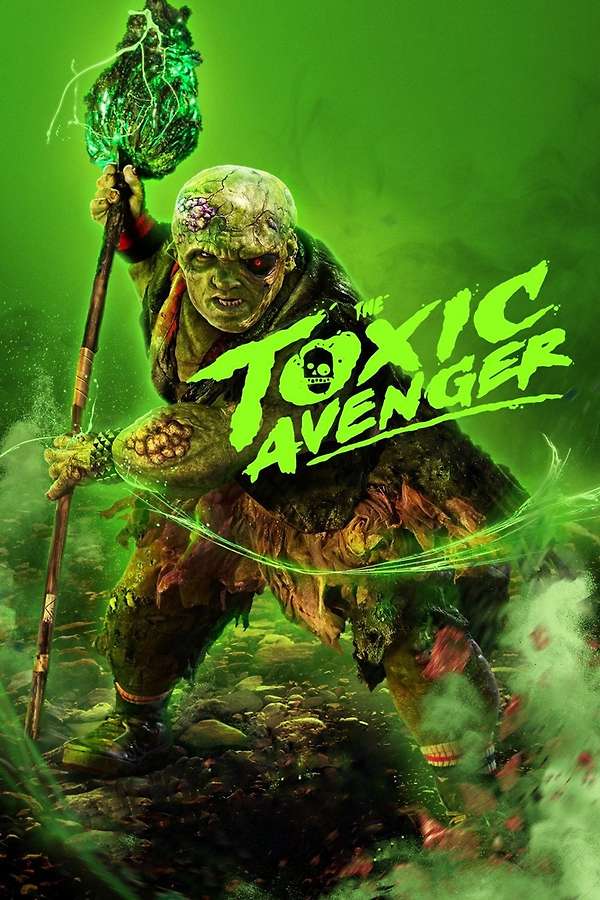
A few years ago when they announced that there was going to be a new ‘Toxic Avenger’ movie (the first in almost 2 decades) I was somewhat hopeful. Troma are not really known as bastions of high quality media. Post millenium Troma even more so. In fact, I’d go as far as to say that pretty much all of the Troma outputs released past 2001 have been frankly quite dire. But Toxie having been rested for so long, I felt had a more than reasonable chance of maybe breaking the curse.
Then they announced the core cast would include Elijah Wood and Kevin Bacon as bad guys and Peter Dinklage was picking up the mantle as Toxie, that the production was being largely handled outside of Tromas production house and that the film would serve more as a modernisation of the original. Essentially a reboot…and I didn’t really know how to feel about it. On the one hand, after ‘Citizen Toxie’ the series probably needed some kind of clean slate to get things back on track. But then; equally, there was concern with the casting that maybe they were stunt casting to mask a bad plot, or even the idea that maybe, with direction and scripting being wrestled away from Lloyd Kaufman, if this would still be the lovable Toxie we know and adore.
Well; I caught this one recently and, I enjoyed it, but it Is a different ball park from the usual fare…
The plot follows Peter Dinklage as ‘Winston’ a widowed father with a disconnected young son who works as a janitor for an evil ‘rejuvenation’ company led by Kevin Bacons Bob Garbinger. Garbingers company is indebted to the mob and pressure is building on Bob on all sides to start producing big stock gains asap after a series of mixed publicity stories claiming Garbingers ‘treatments’ are pumping tons of toxic waste into ‘St. Roma Ville’. While this is going on Winston goes for a check up with his doctors, where they deliver the tragic news that he has a border inoperable brain issue that isn’t clarified, but WILL leave him dead within a year…they say ‘border’ inoperable, because there is one option…But because Winstons on the wrong tier of insurance, he’s inelgiable for it.
Desperate to stay alive for the sake of his son. Winston crashes a fancy banquet hosted by Bob where he manages to get in front of his boss, explain his situation, and plea’s with him to help save his life. Bob seems sympathetic, offering to fully fund Winstons medical costs, before ushering him downstairs and through a door where he promises he’ll discuss things further with him. Only, once Winstons through the door, he finds out that its just a back ally, and listening through the door, he hears Bob sneeringly berating the janitor, telling his staff to ‘fire him, rehire him and then fire him again.’
Devastated and running out of options, Winston goes to steal money, but on escaping from his heist, he gets caught up in a hit on a different person, by a weird rock band dressed as goth clowns, led by Elijah wood. He gets severely injured, and the gang, in an attempt to get rid of the body, dump Winston in a giant storage tank of toxic waste. Transforming little Winston into THE TOXIC AVENGER!
And what follows, is Winston learning about his new found powers, and turning them out for good in an attempt to win over his Son who was very critical of him. While this is going on an undercover group of protestors are trying to find evidence that Bobs business is killing people, and an unholy union forms between them and Toxie, in a action packed 3rd act to bring Justice to St. Roma Ville!
And, there’s kind of a bit to unpack with this one. But on the whole? I enjoyed it. Is it the best Troma movie of this millennium and a new lifeblood into a studio that’s anti PC’d its way through the floor? Im not so sure…
The script itself is sharp, Its leading with a more traditional ‘Super Hero Origin’ trope, which I think is sensible given how much time there’s been between this film and the last time Toxie was anything near a mainstream staple. I would say its less an MCU styled film, and more one borrowing themes and tropes from the likes of ‘Kickass’, ‘The Boys’ and ‘Super’. In the sense that its clearly aimed at a more mature audience who are probably quite aware of super hero origin movies, and because of that it tries to subvert things a little bit to create a sense of comedy or surprise. I think that aspect of this movie works quite well.
However; in that same measure, feels like once the films established that Toxie is a kind of weird looking mutant guy, it doesn’t really seem to know where to go much past there. The promotional material promised over the top gore, guts and blood, and while I can’t say they DIDNT deliver that, those moments are very much relegated to key fight set pieces and that kind of leads me to one of my biggest issues with this movie.
I realised going into this film that this wasn’t going to be the same calibre of strange of bizarre as the original ‘Toxic Avenger’ movies. This isnt an attempt to give Troma fans what they want. Instead? This is more of an attempt at getting a foot in the door with mainstream audiences, especially younger viewers, with the hope of maybe channelling them down to the original films once they’ve invested in this movie. And, I’m fine with that. The way series and franchises survive is to evolve and grow to change styles and to appeal to new people, rather than just giving the bedrock fans exactly what they want by the bucket load, because those guys are always going to turn up.
The secret is to balance giving the existing fans enough to keep them sweet, while modernising and diversifying the series enough to ensure the new people art absolutely alienated by a 40 year old series that AT BEST could be described as ‘incoherent mania on film.’
And that’s kind of the issue I have here, the film is a LOT more ‘straight cut’ than I envisioned it would be. Yes there are still silly, gross out and weird moments. But it feels very much like the production decided to try and tidy things up a bit, winding down the more whimsical cartoony moments, toning the gore and violence down to key fight sequences, and standardising the more surreal elements into a ‘…WELL THAT JUST HAPPENED!’ Style punchline system that a lot of modern films use.
I can appreciate what they’ve tried to do here, and when they do go off the leash on this, it’s great! I think it’s a good balance that’s presented, giving mainstream audiences a fighting chance of getting on board with this series. While giving long time Troma viewers something to savour. But I really do wish this film just had a bit more whimsy about it, I really genuinely missed that cartoonish edge, I don’t need incoherent screaming, or anything like that…But the way this film handles its more surreal elements is to essentially coral them into specific scenes that are signposted heavily. which I thought was a bit disappointing.
There’s also just a broader lack of comically mean villains here, thinking back to the original ‘Toxic Avenger’ the bad guys in that film actively ran over children and dogs for fun. And had an almost childlike hysterics over anything and everything that happens. The main bad guys here are Elijah Woods band…and they don’t get NEARLY enough screen time, nor do they get to do anything particularly comedically scurge worthy. They just shoot some people…and that’s kind of it.
I just feel like there’s an element of total disregard missing from this film, and that kind of energy is what I sought out with Toxie movies. It has its moments, and some of it is genuinely funny. But there was a dark humour to the original series that was so bleak at times it tipped into being hilarious…and this film doesn’t really have that same spark.
I also had some issues with the pacing. The films an hour and forty one minutes long, and it absolutely didn’t need to be. It could have been an hour and twenty and been 20 times better. We get a lot of extended scenes of Winston/Toxie just kind of…going about there day, reflective scenes that happen multiple times that could really have done with being shortened, extended sequences of the villains just…existing. That again, could have been cut all together at no real loss.
The result of them not trimming these moments is that through a chunk of the first act I ended up clock watching waiting for the film to actually get going, then the second act picked up the pace a little bit, but still had extended scenes of just…kinda nothing happening. And finally the 3rd act got the pacing about right, but even so couldn’t quite nail a consistent pace. Slowing and speeding up in places it really didn’t need to, to share information we already kind of knew.
The characters are fine enough, I enjoyed Dinklage as Winston, Bacon and Wood are good foils who, are maybe a little dryer than I’d have liked…But do the job and made me laugh. The supporting cast kind of drift in and out of the film, and while we do ultimately get to know their motivations and drives. I never quite feel like we fully get under the skin of them.
Visually? I have no notes really. The cine has a kind of ‘dirty vibrance’ about it that really appealed, I enjoyed the design choices for Toxie and the villains, the editing is pretty superb all things considered, I really enjoyed the use of practical effects here, and felt that that added some much needed realism. The CGI for establishing shots…I was less keen on.
Direction wise, if the brief was ‘Make a more easily accessible take on ‘The Toxic Avenger’ then I think they absolutely succeeded, this is a tightly orchestrated, grimy, grubby feature that I think most normal folks who wouldn’t have DREAMED of seeing a Troma movie , may actually check out and enjoy. And I really hope that this film gets a TV/streaming distribution deal after its time in theatres, because I’d LOVE to see the elderly guy or gal, channel hopping at 11pm on a weekday who lands on this one!
I’ve largely talked about what I disliked about this movie, but the reality is, I did still have fun with it, I still found it enjoyable, I’d absolutely recommend checking it out for its themes on greedy evil corporate CEOs (something WONDERFULLY relevant in this day and age) its entertaining, made me openly laugh a few times over the runtime and its technically pretty rock solid. Is this the best ‘Toxie’ movie? Absolutely not. In my opinion, the first 2 films are still the high water mark for the franchise. But I’ll say this; ‘Toxic Avenger 2023’ blows ’Toxie’ 3 and 4 clean out of the solar system, and pretty much every Troma and Troma adjacent movie since 2001 out of the dock while its at it!
If you can tolerate the slower portions, and temper your expectations on wacky weird gore and splatter. I think you’ll have a fine enough time with this movie. And I sincerely do hope this one gets a sequel. Or at the very least, that they use this as a base for a ‘Class of nuke’em High’ remake.
source https://letterboxd.com/tytdreviews/film/the-toxic-avenger-2023/


 TYTD Reviews