
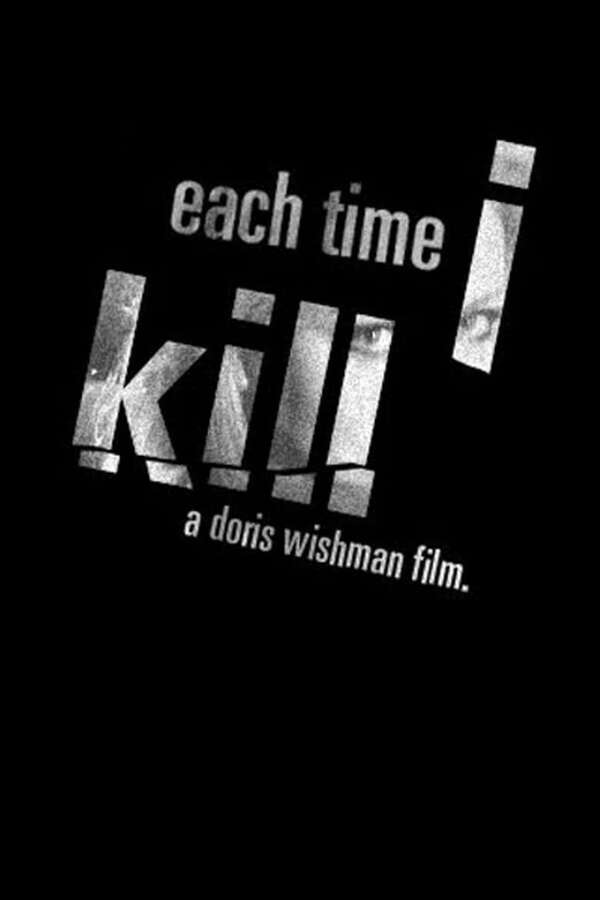
To cap off my summer 'fling' with the world record holder for 'Owner of the apartment to feature in the most movies' Doris Wishman. I decided to catch her final film. 'Each Time I Kill' was shot in 2002, shortly before Doris left this earth and spent 4 years in post production before releasing in 2006 on festival circuits, ahead of a wider release in 2007. And…as far as swansongs go? I simultaineously have to say that this feels like THE most and the LEAST Doris Wishman style movie i've ever seen.
The plot follows 'Ellie' a nerdy girl who's essentially a ghost at her high school (as written by an 89 year old woman) She's ignored by the jocks, bullied by the alt-kids, pitied by the other girls, and her only other friend is an equally unpopular nerdy girl, who Ellie resents to some extent as being essentially her 'only' option.
But Ellie is about to have a flash with fate, when she decides to explore an old abandoned house that local legend states had 'TERRIBLE things happen there to a family'. While exploring, Ellie finds a locket. And on taking the locket home, she discovers that, hidden inside, is a folded up note (printed from a printer and singed with a lighter for some reason…)
The note tells Ellie that this Locket is in fact MAGIC! and has the power to transfer a trait from someone else INTO Ellie. All Ellie has to do is murder the person she wants to steal the trait from, and then read allowed the sacred chant 3 times, and BOOM! whatever Ellie wanted will be transplanted into her, and her weakness in that field will be transferred onto the murder victim.
At first, she's VERY sceptical, but eventually curiosity gets the better of her, and she ends up murdering her school crushes girlfriend, using the Locket to take the girls excellent skin and complexion, and leaving the murdered girl pimply, pale and acne scarred.
Now with immaculate skin, Ellie realises she's dealing with more than a novelty, and sets in motion a plan to create her 'perfect form' using as many girls from her school as it takes to try and win the heart of her crush, while the police follow the trail of 'de-beautied' bodies wondering what the HELL is going on.
On the one hand, the script for this feels very much like Doris was trying to have another roll of the dice at seriously taking on the horror genre after the loss of the original cut of 'A Night to Dismember'. Tonally this film has similar movements and swings that her earlier film had. and I feel like she really wanted to get something out to the public with this one that showed people that she was more than just 'roughies' and Naturist films.
To that point, the script is actually pretty good fun! I cant say its anything *too* original, it has elements of 'Hellraiser', 'May' and other body horror style movies melded together. But it handles its subject fairly well, and at 81 minutes long (I believe the second longest film Doris ever made) It moves at a LOT faster pace than most of her filmography, keeps good pacing through the act structures, has maybe a slightly more bloated 2nd act than the 1st and 3rd do, and while the ending is maybe a little abrupt and feels a bit like the entire film collapsed under its own steam. It at least ends in a way that could be seen as believable, at least it ends in a way that, while maybe not THE most satisfying in the world, didnt ACTIVELY make me angry.
The characters are a little shallow, but do get some good development across the runtime, its a solid little SODV horror film. Maybe not the most bombastic or memorable, but definitely the kind of digi-video film you could play for cult fans and get an accepting thumbs up from the group at the annual SOV Potluck.
Where this falters for me is in the cine and direction. Bearing in mind that most Doris Wishman films i've seen, I've praised how well the direction has been, how decent the compositions and cinematography and sequence building is. Even if the plot wasnt all that solid, you could guarentee there'd be at least a handful of shots in Doris Wishman films of the 60s and 70s that would stick in your mind long after the End title card.
Here? Doris is working with digital video, and may I warmly admit that I found it incredibly respectable that Wishman so readily embraced different formats and genres, like jumping from colour to black and white in the 60s, and jumping head first into early digital effects in the 80s. at 89 years old, Doris saddled up with her lifelong cine collaborator, and got into digital as a format. and for that alone, I feel she deserves some credit…
With that being said, this is probably the worst shot film Doris ever made. I feel like dealing with smaller cameras, the chance to do retakes whenever, and the freedom to just get out and shoot has resulted in a horrendous mixed bag of a viewing experience. The majority of the film flicks between a fish eye lens that is BEYOND distracting and had me groaning whenever it came up, or it was shot with a flat 35-55mm lens of some description with digital zoom features. the result is shots that are flat, have to be digitally manipulated to create depth of field. Feel overly desaturated, and are generally kind of lifeless.
The cine itself is painful, as some shots start with the camera operator still setting up the shot, ground shots being unintentionally blocked by grass and debris, shots that snap in and out of focus as the cameras auto focus tries to catch up, shots that cut too early, shots that run way too late, moments where it feels like there should have been shots (like reverse should shots) that got missed off the shot list. It goes on and on. and I found it very hard to rationalise in my mind that the same person who came up with the beautiful shots of 'Bad Girls Go To Hell' and 'Another Day, Another Man' also shot this.
With that being said, some of the footage DOES accidentally strike on genius at times. Whether intended or not, there are fleeting shots here and there that look great, and feel almost Lynchian in their execution. the film may be VERY rough around the edges, but every so often it'll hit you with something that really makes you stop and wonder if theres life in the old dog yet…they're few and far between! But they are great.
This film also utilizes some early 'plug in' digital effects, that for my money are a bit rubbish, but sincere in their execution. the shot of Ellies first kill is at sea, so they shot the murdered actress against black and then cropped her out against…what can only be described as a 'tone' plate of wavey blue colours…its bizarre honestly, but noteworthy once again in the sense that at least a sincere attempt was made.
Obviously; I cant really comment much on the sequence building and post work, because a lot of it was done posthumously, and honestly; who knows if Doris would have approved the cut that eventually made it to screens? What I can say is its rough. sometimes its functionally passable, but for the most part, as with Doris's 70s work, continuity was firmly in the garbage, the line, was nowhere to be found, and everything was basically in free flow till Doris said she was happy. I cant rate the edit for this one personally; but I know some folks who like trippy edits, or bad cuts who'd really get a good time out of this one.
Performance wise, Tiffany Paralta is our lead as Ellie and…she's fine. Middle of the pack in my opinion compared to the other leading ladies Doris worked with. Her performance ranges from actually pretty solid in places, to hamstrung by the VERY cheap prosthetics used to 'ugly-fy' her, to a total swing and a miss on deliveries. I dont think she gives the best physical performance in the world. But every so often she brings the kind of energy that makes me want to watch a Doris Wishman flick.
The supporting cast are all fairly mixed, nothing standout awful…but nothing particularly noteworthy either. As with a lot of Doris movies, the supporting cast largely feel 'benched' until they're needed to have sex, be murdered or have sex and THEN be murdered. Window dressing essentially. Though; this time, given how many years Doris had been in the Biz, she had some showbiz help, in the form of very brief cameos from Fred Schnider (of the B52's fame), John Waters, Linnea Quigley and Frank Hennenlotter. Oh yes…its a regular 'Whos Who' this movie is! Non of them steal the show, but it does show the sense of community these people had, and the connection the cult world has running right through all its eras.
As for the soundtrack? its an ADR fest, and I wouldnt have had it any other way, its not great…and I wouldnt have had it any other way, and the music is library tracks and stuff written by one of her relatives…and I wouldnt…have it…any… … other way.
Also; please pour a glass out, for the final time we'll see Doris Wishmans apartment or…condo or…im not sure anymore…GONE BUT NOT FORGOTTEN!
All in all? I had a real soft spot for this one, like 'Night to Dismember' it feels like Doris is having a sincere crack at a genre she wasnt commonly involved in. and I think shes actually wonderfully weird and great at it. I actually lament a bit the fact she didnt get the chance to explore straight horror and science fiction a bit more in her lifetime. As I think there was a lot of potential there for her to have mined.
As it stands? 'Each Time I kill' is a fine enough end to the career of Doris Wishman, something semi-reflectant of her style and work, while also pushing into new and strange territory. This film isnt a good reflection of the body of Doris's work, and as such I cant recommend it as a film for people to get a foot in the door on her filmography. And I dont think I could recommend it to straight horror fans in the way I could recommend the original cut of 'A Night to Dismember'. Its a bit too self referential for that.
But if you've watched all of Doris's other movies, this is a bittersweet full stop on a career that made 'Naked lunch' read like 'Sense & Sensibilities' and I feel you'll really appreciate this if you meet it on its own terms.
source https://letterboxd.com/tytdreviews/film/each-time-i-kill/

